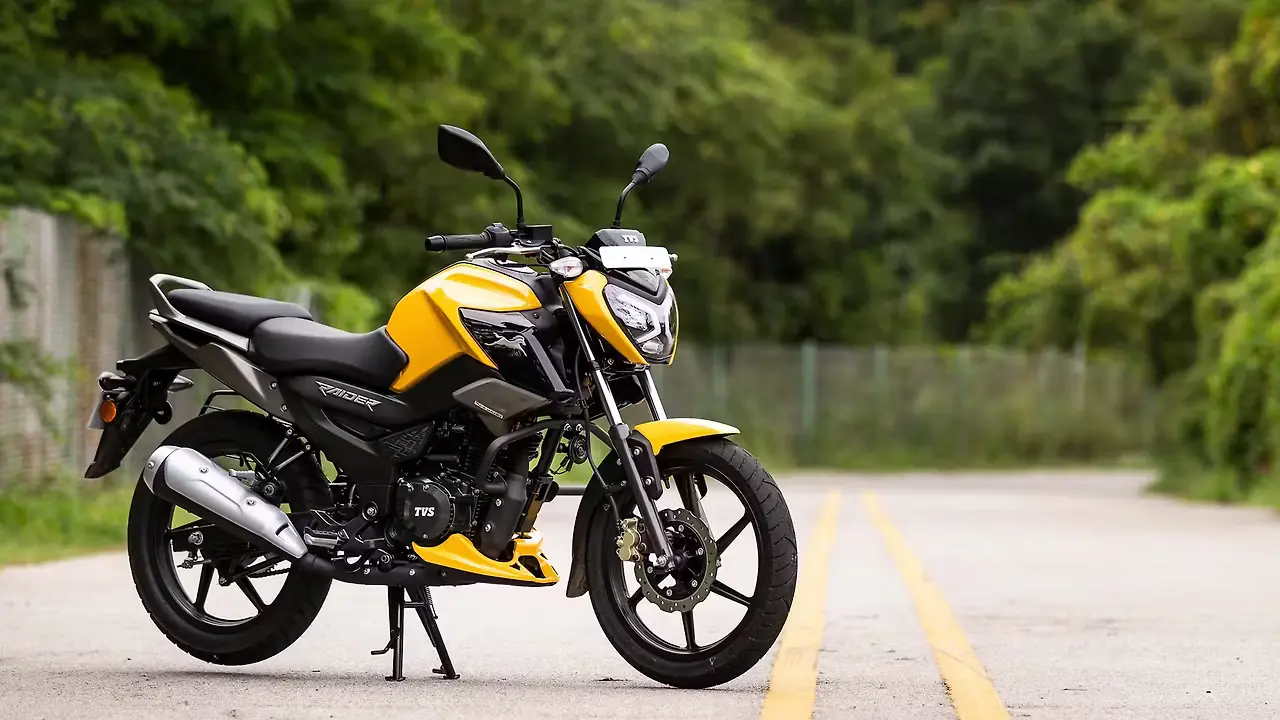
I still remember the first time I saw the TVS Raider 125 — its sharp lines and bold colours made me stop and look. If you are a young rider or just someone who wants a fun, efficient commuter, this bike was built with you in mind. In this post I’ll walk you through why the Raider 125 is winning hearts: from its sporty design and useful tech to real-world mileage and the 2025 safety upgrades that make it even more appealing.
Sporty Design and Practical Ergonomics
The Raider 125 looks like a naked streetfighter, and TVS clearly aimed this bike at Gen‑Z and new‑generation buyers. You get a sharp LED headlamp with DRL, aggressive tank shrouds, split seats, and 17″ alloy wheels. The bike rides light — kerb weight is around 123–125 kg depending on the variant — so it feels nimble in traffic.
Ergonomically, the seat height is a comfortable 780 mm with a 10 L fuel tank and 180 mm ground clearance. That combination makes it easy to hop on and off and confident over city humps and potholes. TVS also released themed editions like the Super Squad to target younger buyers who want style and personality.
Engine, Performance and Real Mileage
Under the tank is a 124.8 cc air + oil‑cooled, 3‑valve single that produces roughly 11.2–11.38 PS of peak power and about 11.2 Nm of torque (with the iGO/Boost system you can see ~11.75 Nm). The bike has a 5‑speed gearbox and TVS claims brisk in‑gear acceleration — 0–60 km/h in about 5.8–5.9 seconds when using Boost/iGO.
Fuel economy is a strong suit. The ARAI‑certified number is 56.7 kmpl, and owner reports typically range between 55–65 kmpl depending on riding style and city vs highway use. On a full 10 L tank that translates to a theoretical range of around 560 km at the ARAI figure. In real life I’ve seen riders regularly hit mid‑50s kmpl in mixed commuting.
Modern Tech and Connectivity
One thing that makes the Raider 125 feel modern is its instrument and connectivity package. TVS uses the SmartXonnect platform with Bluetooth pairing, call and message alerts, voice assist and turn‑by‑turn navigation. You can choose between a colour TFT dash (top trims) or a reverse LCD dial (other trims). The top TFT offers over 99 features while the reverse LCD trims list around 85 features, so you get a lot of tech even on mainstream models.
Two other systems worth noting: iGO Assist (an ISG‑based Boost mode) gives a quick torque bump of about 0.55 Nm for overtakes; and GTT (Glide‑Through‑Technology) eases crawling and stop‑go traffic. Together they make the Raider feel sprightly and easy in city riding.
Safety Upgrades and Hardware (2025)
The 2025 update brought meaningful safety upgrades that are rare in this class. TVS introduced dual‑disc variants — the SXC DD and TFT DD — that add a front and rear disc with single‑channel ABS. These trims also get wider tyres (front 90/90‑17, rear 110/80‑17) and a handy Follow‑Me headlamp that stays on briefly after you switch the bike off.
Those changes improve braking feel and grip — important if you ride aggressively or carry a pillion. For many younger riders who like to push handling limits and want extra safety, these hardware upgrades make a real difference.
Variants, Pricing and Quick Spec Table
TVS offers the Raider 125 in multiple trims — from simple drum‑brake commuter variants to feature‑rich TFT editions and the 2025 dual‑disc versions. Prices vary by state and trim, but the new dual‑disc models sit at:
| Variant | Key Features | Ex‑Showroom Price (approx.) |
|---|---|---|
| Raider Drum / Base | Drum brakes, reverse LCD, simple kit | ~₹80,500 |
| Raider iGO / Boost | iGO/Boost mode, SmartXonnect, better trims | ~₹98,300 |
| SXC DD (2025) | Front+rear discs, single‑channel ABS, wider tyres | ₹93,800 |
| TFT DD (2025) | Colour TFT, dual discs, ABS, premium features | ₹95,600 |
| Special / Super Squad Editions | Themed graphics, unique colours | Varies (limited) |
Note: prices are ex‑showroom and approximate; state taxes and registration will change on‑road cost. Overall, the Raider sits in a competitive band (roughly ₹80.5k–₹1.05 lakh) depending on trim and features.
Real-World Impressions and Market Traction
We can judge a bike by how it performs in everyday life and how buyers respond. Owners report that the Raider feels light, eager in city traffic, and economical on fuel. Real‑world mileage averages around 56 kmpl for many riders. TVS also announced the Raider crossed one million sales in about three years — a clear sign buyers like what it offers.
For example, a long‑term owner I read about used the iGO variant for daily 30–40 km commutes and occasional highway runs. They averaged about 57 kmpl and praised the GTT for reducing clutch work in traffic. Another rider who upgraded to the DD trim said the wider tyres and rear disc improved confidence during wet braking.
Also Read: Yamaha XSR 155: Modern-Retro Style and Powerful Features That Will Win Your Heart
Final Thoughts
To sum up, the TVS Raider 125 is a strong package for young, feature‑seeking commuters. It blends sporty styling, modern connectivity, and efficient performance while offering real safety upgrades in the 2025 dual‑disc variants. If you want a 125cc that stands out visually, is fun in city traffic, and still returns excellent mileage, the Raider is hard to beat.
If you’d like, I can give a one‑line buying recommendation comparing the Raider to rivals (Hero Xtreme 125R, Bajaj/Pulsar 125, Honda 125), pull up exact state‑wise variant prices, or fetch owner forum excerpts about long‑term reliability and mileage. Which would you prefer?