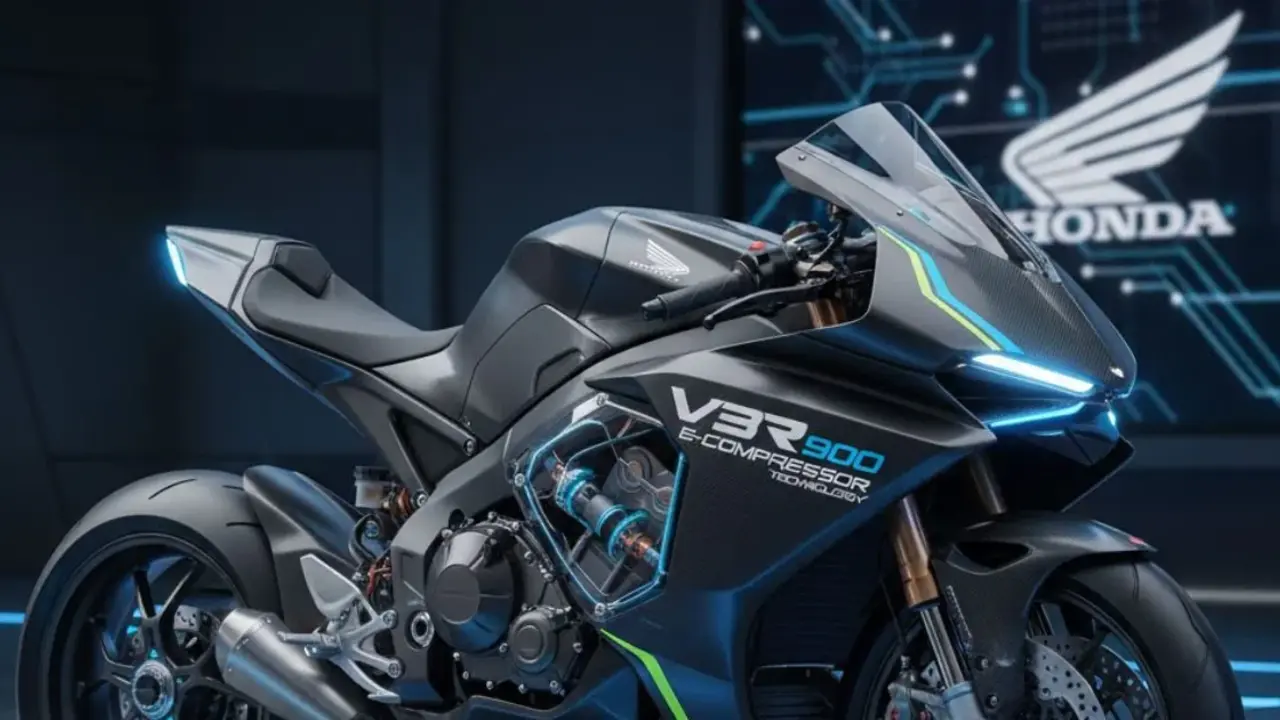
I got a close look at Honda’s bold idea at EICMA, and I want to help you understand Electronic Compressor Technology and why the new V3R 900 prototype matters. Honda revealed the V3R 900 E‑Compressor Prototype at EICMA (Milan) on November 4, 2025. This bike pairs a compact 900 cc 75° V3 engine with an electronically‑controlled compressor — a first for motorcycles, according to Honda. Let’s walk through what that means in plain language.
What exactly is an electronic compressor?
Think of an electronic compressor (often called an e‑compressor) as a small, very fast electric pump for the engine’s air. Instead of waiting for exhaust gas (a turbo) or running off the crankshaft (a mechanical supercharger), an e‑compressor uses an electric motor to push extra air into the engine on demand.
That simple change lets the bike get instant boost anytime you need it. Electronic Compressor Technology means the boost level is controlled by software, so Honda can dial in power right away at low rpm, cut boost when needed to save fuel, and tailor response for different riding modes.
How the V3R 900 uses the tech
At EICMA, Honda showed the V3R 900 prototype with a water‑cooled 75° V3 engine confirmed at 900 cc. The headline claim: the e‑compressor lets this 900 cc engine feel like a much larger engine — Honda compares it to a typical 1,200 cc unit for performance, while keeping better efficiency than a bigger naturally aspirated engine.
Key points we know from the reveal:
- Prototype shown at EICMA Milan press days (Nov 4–5, 2025).
- Compact packaging and centralized mass thanks to electric drive for the compressor.
- Boost is independent of exhaust energy and engine rpm.
- Honda has not published final horsepower or torque numbers yet — they are still testing.
How e-compressors compare to turbos and superchargers
I find a table helpful when comparing systems. Below I put the three main forced‑induction types side by side. This shows the tradeoffs you can expect on a motorcycle like the V3R 900.
| System | How it works | Response | Packaging | Fuel/efficiency |
|---|---|---|---|---|
| Electronic compressor (e‑compressor) | Electric motor powers a compressor; boost on demand | Very fast; near‑instant boost | Compact options; flexible placement | Good; can be optimized by electronics |
| Turbocharger | Uses exhaust energy to spin a turbine/compressor | Delayed at low rpm (lag) unless twin/turbo tech used | Needs exhaust plumbing and often intercooler | Very efficient at high load; complex packaging |
| Mechanical supercharger | Driven directly by engine (belt/gear) | Immediate response, but power draw from engine | Mounted on engine; increases rotating mass | Less efficient due to parasitic loss |
Why this matters for riders and design
I’m excited by three real advantages for riders:
- Instant low‑end torque — The e‑compressor gives strong pull from low revs, which helps in city riding and out of corners.
- Cleaner packaging — Because it doesn’t rely on exhaust flow, engineers can place the compressor where it helps balance the bike. Honda pointed to a compact layout and a more centralized mass in the V3R 900 prototype.
- Smart control — Electronics let you tune boost per riding mode, manage emissions, and reduce fuel use when full boost isn’t needed.
Honda also notes cooling benefits. Traditional turbo systems often need big intercoolers and long plumbing. The e‑compressor approach may remove some of those constraints and let designers keep a tighter, sportier look like the V3R 900’s asymmetrical fairings and single‑sided swingarm.
Real examples, context, and what remains unknown
We’ve seen forced induction on motorcycles before — Kawasaki’s supercharged models are a notable example. What’s different here is the fully electric drive and electronic control Honda calls a “world‑first” for bikes. In cars, manufacturers like Garrett and others already use electric compressors on hybrids for fast boost and emissions control.
At EICMA Honda made a bold performance comparison: the 900 cc V3 with E‑Compressor could perform like a 1,200 cc engine. That’s a clear promise, but Honda didn’t publish exact horsepower or torque numbers at the prototype stage. So while the claim is exciting, we still need test figures.
Here’s what I’m watching for in future announcements:
- Official horsepower and torque numbers from Honda.
- Real‑world fuel economy and emissions testing.
- Reliability info and service approach for the e‑compressor system.
- Production timeline and pricing, if Honda decides to move forward.
Honda says the V3R 900 prototype is being developed toward a possible production model, but no timeline was announced at EICMA 2025.
Design and rider experience — what the prototype showed
On the show floor the V3R 900 prototype had a streetfighter stance with vertical LED headlamps and an asymmetrical body. Honda highlighted the new “Honda Flagship WING” tank emblem and a single‑sided swingarm. These are styling cues, but they also reflect how the packaging freedom from the e‑compressor lets designers try new layouts.
For riders, that could mean better handling from more centralized mass and an engine that feels punchy without a heavy mechanical supercharger. If Honda can deliver the promised 1,200 cc‑like performance from 900 cc, riders would get strong acceleration with potentially lower fuel use.
Also Read: Royal Enfield Classic 650 Unveiled: Shiny Gold Color, Aggressive Look, and a Powerful Retro Style
Final Thoughts
In short, Electronic Compressor Technology is an important step for motorcycle engineering. Honda’s V3R 900 prototype shows how an e‑compressor can give instant boost, cleaner packaging, and smarter control compared with classic turbo or mechanically driven systems. Honda revealed the bike at EICMA on November 4, 2025, and the 900 cc 75° V3 engine is a compact, intriguing platform.
We still don’t have final power or torque numbers, pricing, or a production date. But the V3R 900 puts Honda back into the forced‑induction conversation with a novel, electronically controlled approach. If you want, I can pull direct quotes from Honda’s press release or track follow‑up coverage like dyno tests and production announcements and send you updates. Which would you prefer?